Psychological intelligence from natural speech

See the person before
you make the decision.

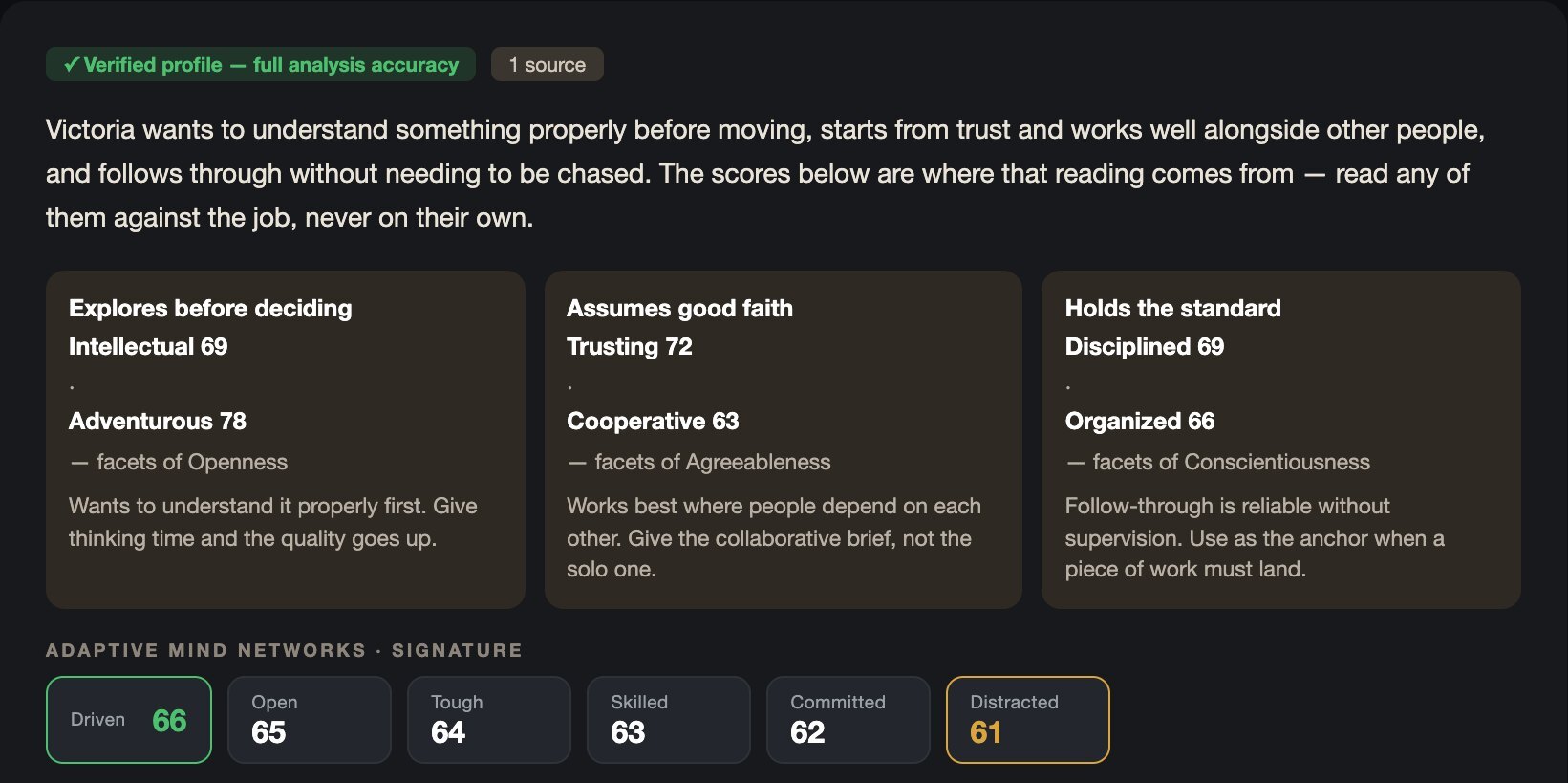
Vantage reads personality, what drives someone, and how they hold up under pressure — from five minutes of natural speech. Observed, not self-reported. No questionnaire, no test to sit, nothing to game.

Bring someone you know inside out. A public interview will do. Judge us on what comes back.

Built for decisions that carry weight
Chosen by the United Nations
Responsible Innovation AwardWorld Economic Forum, Davos 2024
Top 10 Most InnovativeSports Business Journal
Featured by the BBC
Engineered over four yearsat Google Campus, London
The problem this exists for

Almost nobody misreads
a person on purpose.

Senior decisions are made in a narrow world. The shortlist is small, the room has known each other for years, and confidence is high. Familiarity gets read as suitability — and the people deciding cannot see it happening, because by definition they never could.

More training on being fair does not fix this. People already believe they are being fair, and they are mostly sincere about it. What changes the outcome is a process where the signals that trigger the pattern-matching are simply not present to be weighed.

“The more senior you get, the more that world narrows, and the more bias creeps in. It's rarely intentional — people are just unaware of it.”

Group Head of Learning & Development, national retail group
What it actually reads

A person has three layers.
Most instruments read one.

The framework is Dan P. McAdams and Jennifer Pals', published in American Psychologist and now the standard integrative model of the whole person. Vantage reads all three from the same five minutes.

LAYER ONE

The Actor

The personality you were more or less born with — the way you naturally behave. Quiet or loud, cautious or bold, steady or restless. This is where conventional psychometrics stop.

LAYER TWO

The Agent

What actually drives you. Two people with near-identical personalities behave completely differently because one is chasing recognition and the other wants to belong. Motivation multiplies personality — or cancels it.

LAYER THREE

The Author

The story someone tells about their own working life. Narrative moves first when a person rises or falls, and it predicts wellbeing over and above traits alone.

What that gives you

Three reads. One instrument.

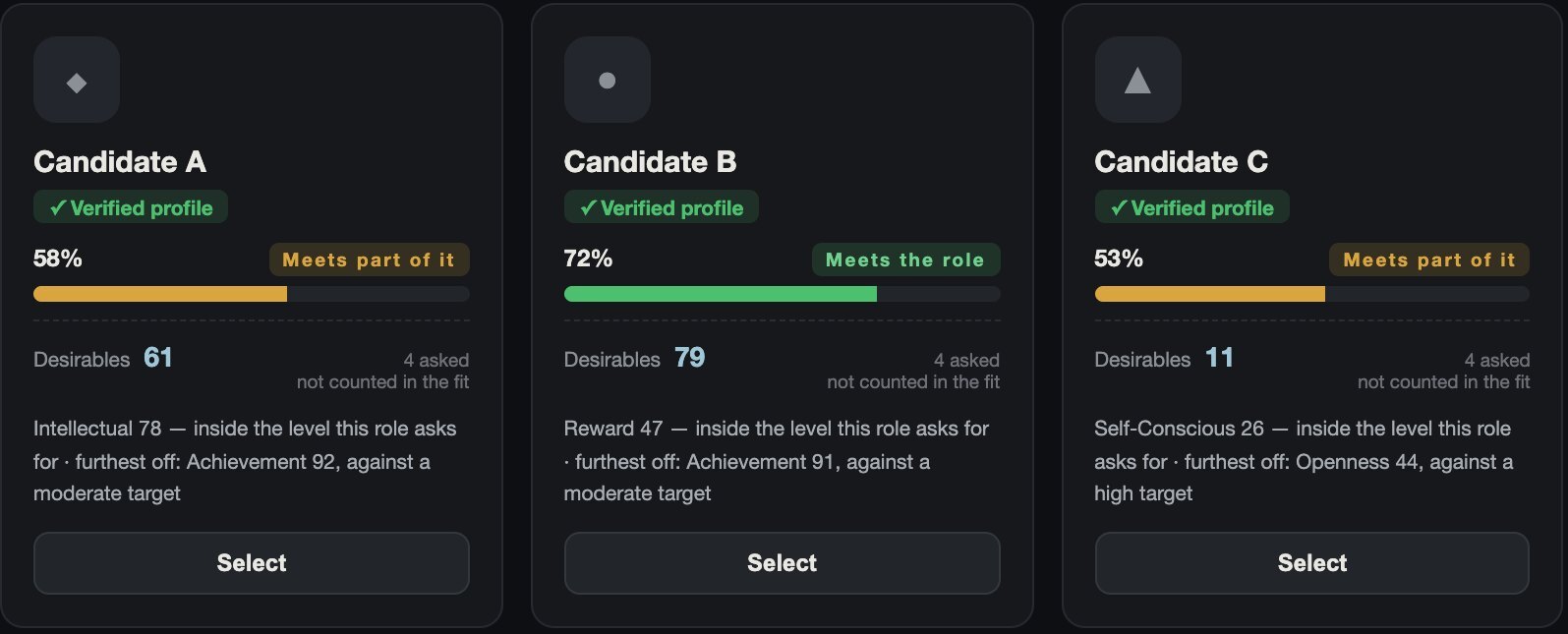
01 · THE PERSON

Judge without the bias

Blind Audition strips the name, gender, age, school and employer out of the transcript before anyone reads it. Candidates are assessed on psychology against the role you defined — and the decision is sealed and timestamped before any identity is revealed.

You get: a defensible decision, and a record of exactly how it was reached.
Read the Blind Audition paper →
02 · THE ROOM

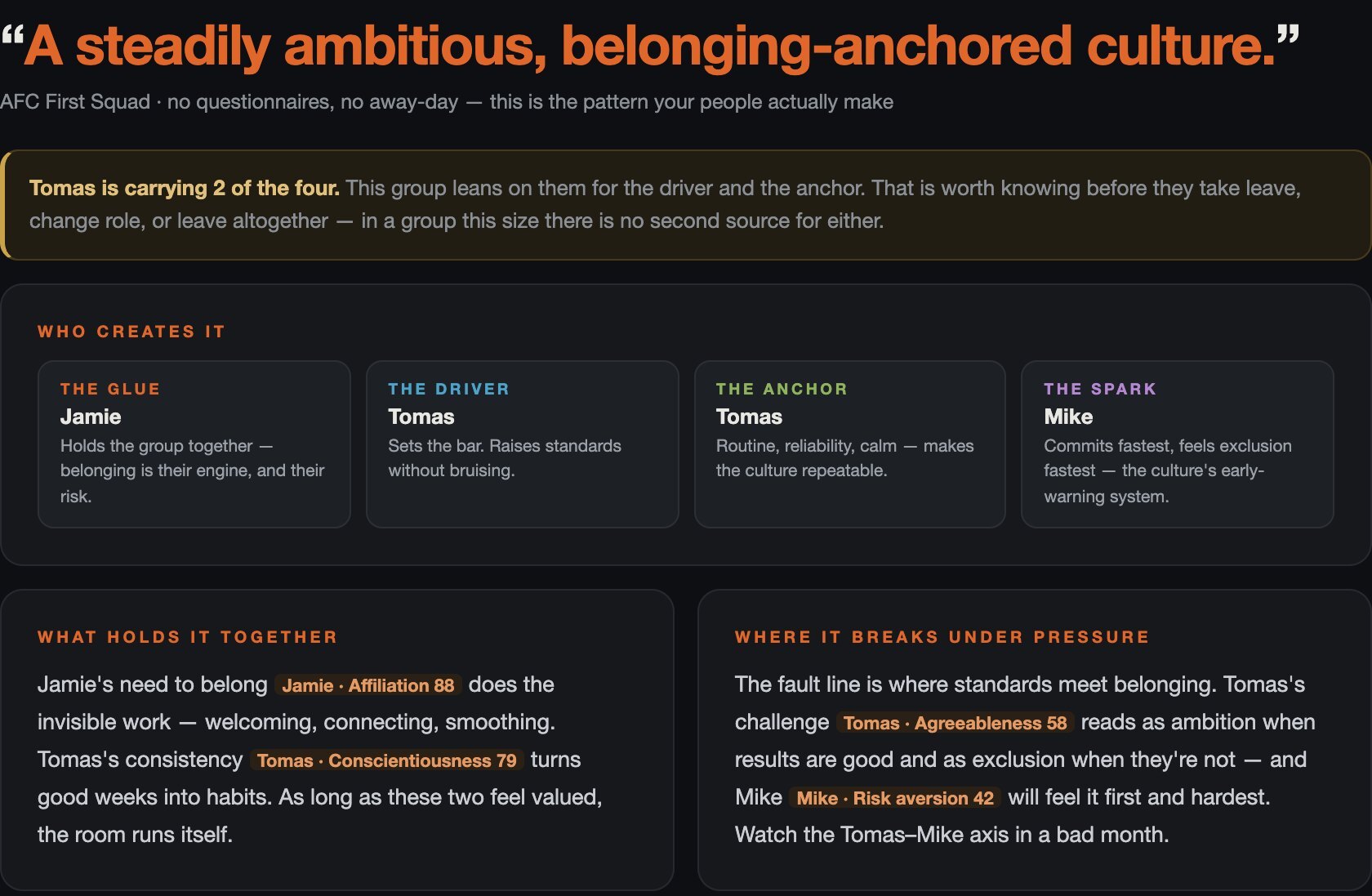
See your culture as it is

Culture reads a team as one living thing and names who holds it together, who sets the standard, who makes it repeatable and who feels the cracks first — then shows where it breaks under pressure.

You get: a verdict, four named roles and three moves — every claim traceable to a score.
Read the Culture paper →
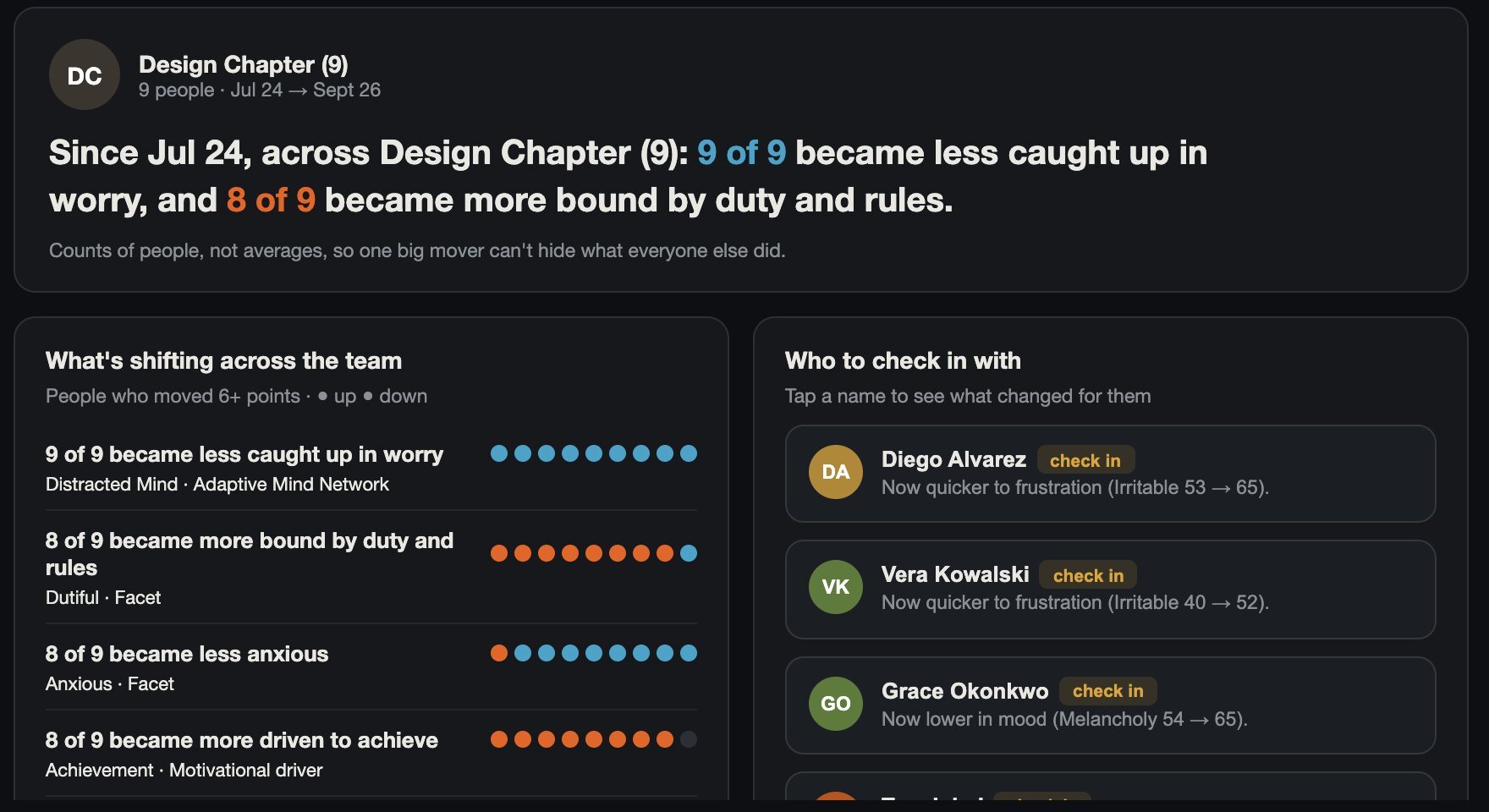
03 · THE CHANGE

Read it again as it moves

Personality is a range, not a fixed point, and context decides where in that range someone lands. Read the same person or team again after a hire, a promotion or a hard quarter.

You get: movement you can act on, long before it surfaces as a resignation.
How it works

Five minutes of speech.
Nothing to fill in.

01 — GIVE IT SPEECH

A recording you already have

A Teams or Zoom call, an interview, a press conference, a podcast. Five minutes of natural speech is enough. Nobody sits a test, so there is nothing to prepare for.

02 — IT READS THE LANGUAGE

Structure, not sentiment

Not the topic, and not the mood — the patterns in how language is used. This is the Pennebaker tradition of language-based assessment, not sentiment analysis.

03 — YOU DECIDE

Ask it anything, in plain English

“How do I onboard this person?” “Will they fit this team?” Insight Vault answers and cites the scores behind every claim. Vantage never makes the decision.

On screen

Evidence you can interrogate.

No radar charts, no colour types, no personality labels to become. A verdict in plain language, the roles that create your culture, and the fault line that opens first when the pressure comes on.

Every claim ties back to a number, and every number ties back to the language that produced it. Where the evidence isn't sufficient, the platform says so — clearly.

VANTAGE · LEADERSHIP TEAM — CULTURE
THE GLUE
Priya
Holds the group together.
THE DRIVER
Marcus
Sets the bar.
THE ANCHOR
Ade
Makes it repeatable.
THE SPARK
Nina
Feels the cracks first.
Where it breaks under pressure — the fault line sits where standards meet belonging. Marcus's challenge reads as ambition when results are good and exclusion when they're not, and Nina will feel it first.
Affiliation81
Composure64
Agreeableness38
Why this is measurement, not opinion

Observed, not self-reported.

Every psychometric you have bought asked the person to describe themselves. Vantage asks them nothing — and on the outcome employers care about, that turns out to matter.

66,732

People whose language was analysed to validate language-based personality measurement. It agreed with both self-reports and informant reports, discriminated properly between traits, and stayed stable across six months.

Park et al. (2015), Journal of Personality and Social Psychology
44,178

People across 263 samples in the meta-analysis showing that assessment from outside the person predicts job performance better than self-assessment — and adds what self-report misses entirely.

Connelly & Ones (2010), Psychological Bulletin
Whole trait

A trait is not a fixed point but a distribution of states. The typical person routinely displays nearly all levels of all traits — which is why one reading is never the whole picture.

Fleeson (2001), Journal of Personality and Social Psychology

Motive scoring from natural speech follows Winter's running-text method, validated against the original TAT measures. Full reference list available on request.

The people behind it

Built by people who have lived
at the highest level of human performance.

PREMIER LEAGUE
Malcolm Frame
Head of Psychology

More than two decades inside Premier League football, leading psychology at Southampton FC — home of one of the game's most respected academies. He pioneered emotional-intelligence development for academy players and founded the club's Learning Lab research programme with university partners, funding doctoral research into how elite skill is really built.

His career has asked one question: what makes the performer, beneath the performance?

UK SPECIAL FORCES
Floyd Woodrow MBE DCM
Head of Performance

Selected for the SAS at 22 — among the youngest ever — and graded in the top 1% of its officers across a full career with 22 Special Air Service Regiment. Decorated twice: the Distinguished Conduct Medal for gallantry in Iraq, an MBE for his work in Afghanistan.

He finished his service leading the UK Special Forces Counter Terrorist Wing, studied law and psychology while serving, and created the Compass for Life framework.

TECHNOLOGY
Walter Farfan
Technology & Scale

Builds the technology that turns deep human understanding into something organisations can use — clearly, consistently, at scale.

The Vantage engine was developed over four years from Google Campus London, where behavioural science met machine intelligence, and was recognised for responsible innovation at the World Economic Forum, Davos 2024.

One of them owns the psychology of the world's most scrutinised talent pipeline. One of them owns leadership where the cost of misreading a person is absolute. The third made what they know into an instrument. That is who reads your five minutes.

Before you ask

What Vantage is not.

Not a test. There is nothing to sit and nothing to prepare for — so there is nothing to game.
Not sentiment analysis. We read the structure of language for personality and motivation, not mood or tone.
Not a personality type. No colours, no quadrants, no labels to become. A reading, not an identity.
Not a decision-maker. Vantage never selects, ranks or rejects anyone. A human always makes the call.
Not a wellbeing or clinical instrument. It reads role fit and team effectiveness, not health.
Not a replacement for what you already own. Existing psychometrics stay useful — Vantage reads what they were never able to.

“It lets a senior leader set the ego aside. They're still in control, they still make the decision — they're just making it with more than instinct.”

Group Head of Learning & Development, national retail group
Where organisations use it

The right talent and the right person
are not the same thing.

Senior hiring & succession

Where the shortlist is small, everyone already knows each other, and nobody in the room can read it cleanly.

Onboarding

How to reach this particular person in their own language — from the first week, not after six months of guessing.

Retention

People rarely leave over money alone. See who has stopped identifying with the culture while there is still time to act.

Leadership teams

The room examined least and mattering most. See it clearly without anyone having to say it first.

Restructure & merger

Two cultures becoming one — read both before assuming they will blend, and see where the fault lines will actually sit.

Developing your managers

Run it alongside a decision they have already made. The gap between the two is the most useful coaching conversation available.

Published, so you don't have to ask

What it costs.

Most instruments in this category are demo-gated and quote on application. Ours are published, because a price you have to earn a meeting to hear is not a price.

FIRST PROFILE
£299 one-off
Credited in full when you upgrade
  • 1 verified profile
  • Insight Vault — 14 days
  • 1 seat
  • No exports
FOUNDATION
£2,500 / month
12-month term · £250 per profile
  • 10 profiles / month
  • Insight Vault — unlimited
  • 3 seats · groups · compare
  • PDF exports
PERFORMANCE
£5,000 / month
12-month term · £200 per profile
  • 25 profiles / month
  • Blind Audition — sealed, bias-free selection
  • White-label exports under your own brand
  • 5 seats · groups · compare
ELITE
£7,500 / month
12-month term · £150 per profile
  • 50 profiles / month
  • Blind Audition & white-label exports
  • Unlimited seats · quarterly consultancy
  • Data API into your platform

Monthly allowances refresh each month of the term. Organisation plans — 100+ per month, multi-team, governance module — by proposal.

Questions we get asked

The two things every buyer
checks first.

One is whether the science holds. The other is where the data sits. Both are fair, and both have straight answers.

Does the science hold?

How can five minutes of speech tell you anything reliable?
Because how a person talks about pressure, ownership and belonging carries a measurable, stable signal — and reading it computationally is an established method with published validation, not an inference we invented. Park and colleagues analysed the language of 66,732 people: language-based measures agreed with both self-reports and informant reports, discriminated properly between traits, and stayed stable across six months. Park, G., et al. (2015). Journal of Personality and Social Psychology, 108(6), 934–952.
Surely a questionnaire the person fills in is more accurate?
It is the intuitive assumption, and the evidence points the other way. On the outcome an employer cares about — job performance — assessment from outside the person predicts better than self-assessment. Connelly and Ones meta-analysed 263 samples covering 44,178 people and found observer-based ratings produced predictive validities substantially greater than, and incremental to, self-ratings. Connelly, B. S., & Ones, D. S. (2010). Psychological Bulletin, 136(6), 1092–1122.
Is this just another Big Five test?
No. Vantage reads all three levels of the standard model of personality — dispositional traits, the drives beneath them, and the story a person tells about their working life. Most instruments stop at the first. The three-level architecture is McAdams and Pals' framework, published in American Psychologist. McAdams, D. P., & Pals, J. L. (2006). American Psychologist, 61(3), 204–217.
What if someone is having a bad day?
That is the point rather than the flaw. A trait is not a fixed point — it is the distribution of how someone behaves across situations, and the typical person routinely displays nearly all levels of all traits. So one reading is a moment. Read the same person again in a different context and you get the shape, which is the thing worth managing. Fleeson, W. (2001). Journal of Personality and Social Psychology, 80(6), 1011–1027.

Where does the data sit?

Who is responsible for the data — you or us?
Your organisation is the data controller: it is your decision, your process, your relationship with the person. We are the data processor. We analyse what you lawfully send us, on your written instructions, and nothing else. We will sign a Data Processing Agreement that says exactly that.
Do you train your models on our data?
No. Client recordings, transcripts and profiles are never used to train, tune or improve our models. Doing so would make it our purpose rather than yours, and would change our legal position as well as yours.
Do candidates and employees have to be told?
Yes, always — and it is straightforward. A short, clear paragraph in the interview invitation covering what is recorded, why, who sees it, how long it is kept and how to request a human review. We would steer you away from a consent tick-box: consent must be freely given, and a candidate rarely feels free to refuse. Legitimate interests with genuine transparency is both more honest and more defensible.
Does the system make the decision?
Never. Vantage returns a read and the evidence behind it; a person decides. That is a deliberate design choice with legal weight: under the UK GDPR as amended by the Data (Use and Access) Act 2025, a decision is only "solely automated" where there is no meaningful human involvement — so a correctly run process sits outside the most heavily regulated category of processing entirely.
Is this employee surveillance?
No, and we will tell you where the line is. Reading a team to understand how it works is different from monitoring individuals, and repeated reads of the same people become workplace monitoring — which has to be necessary, proportionate and openly disclosed. We advise reading the group rather than scoring individuals, and we do not support covert use.
Put Vantage to the test

Bring us someone you
know inside out.

A colleague, a leader you have worked with for years, or yourself. A public interview or a recorded call is enough. We will read them, and you can judge the instrument on whether it tells you something true.

No presentation first. No promise to take on trust.